I grew up during as time when the wearing of bicycle helmets wasn’t really a thing. And how could it be? I couldn’t wear a helmet while wearing earphones to my walkman, now could I? This was long before the advent of earbuds but honestly, as long as I was wearing a ball cap to protect my scalp from the sun and I was home before dark, my parents never imposed the wearing of a bike helmet. These days? Depending on the community you live in, the requirement of a bike helmet may be law. But there isn’t a day where I don’t see multiple people cycling in heavy traffic areas without a helmet.
It is what it is. Some people are more apt to follow rules and best practices than others. But the curious thing is, what purpose does a bike helmet serve? If you’re a young child and you happen to topple sideways on your bike, a helmet may save your skull from cracking on the edge of a sidewalk; no question. But whether you’re a child or an adult, you’re helmet won’t save you from any significant incident, such as getting struck by a moving car. This makes one wonder why it’s considered so necessary on most cases. And this post is about all of those little “rules,” not just bicycle helmets.
The reason behind certain rules and regulations isn’t always clear. And more often than not, it can seem unnecessary and perhaps even excessive. Especially if you find yourself on the receiving end of a penalty in relation to any of it. One good example is last week, when I was issued a traffic ticket for performing an “illegal” turn. I won’t get into the specifics of the ticket, other than to say that I definitely performed the alleged action, and the section of legislation does render it unlawful. So I really can’t argue the traffic ticket. But I couldn’t help but feel that I had done nothing wrong or unsafe and that being issued a ticket because of it was rather ridiculous.
The point behind today’s particular rant, is that even though it seemed perfectly safe and acceptable to me, doesn’t mean that it would be to everyone. In most cases, an incident likely occurred that led to that action becoming unlawful. By that logic, it becomes important for people to observe those laws and abide by them. Not only for their own safety, but the safety of others. At the risk of opening my comments section up to a plethora of argumentative points of view, this concept applies to a lot of rules, regulations and laws that are being enacted in response to the current state of the world. Some of them may seem unfair or excessive, but they all have the aim to protect and safeguard the population as a whole.
Most people can’t discern the difference between their “rights” and doing “what’s right.” The two often don’t go hand-in-hand and don’t always apply to one another. And sometimes, we need to abide by certain rules in order for society to continue to function normally. This is the cost of living in a modern society where we live in mass gathering of populated towns and cities. I’m quite certain that if a vehicle clips me while I’m out cycling, my helmet likely won’t do a damn thing to save me. Just like wearing a face mask “may” do nothing for me or the people around me. But I acknowledge two things: the first is that I can still observe my rights as a person while abiding by the rules. The second is that it costs me nothing, which tends to make peoples’ theatrics over most of these issues more than a bit ridiculous. this is why you’ll always see me do both those things, so long as it’s required of me. Food for thought… ☯️
Sometimes, and especially in extent years, I tend to forget that working towards the elimination of suffering within my own life and to a degree, the life of others, is an important part of my Buddhist studies. People have occasionally asked me why I always say that I STUDY Buddhism as opposed to practicing it. The answer to this is quite simple. Because I AM studying it. While I tend to live my life according to some of the concepts and precepts behind the Zen Buddhist faith, I don’t believe that my study of its background and history necessarily makes me an active practitioner. Perhaps I’m wrong and I have been what would otherwise be considered an active practitioner through these recent years. After all, my mother was a devout Catholic her entire life but I can’t recall her ever abstaining from meat on Fridays, going to confession or even observing Lent (although a few times during my childhood, she put off bingo during Lent). In more recent years, she hasn’t even attended Sunday mass. But she still considers herself Catholic.
One of the traits I most admire about my mother is her belief that religion and how we choose to observe it is a personal choice. Because of this, she’s long felt that she doesn’t need to go sit in a random building while listening to someone else read from a bible when she can simply do it herself at home. A pretty enlightened perspective, if you ask me. And I do tend to share that perspective, albeit under the umbrella of a different faith that came along my path by virtue of my martial arts studies and my travels to Japan. I began studying Buddhism over 25 years ago, when karate guided me in the direction of breathing, meditation, finding one’s centre and balance. Because of this, I began looking at some literature attached to Bushido’s Code and Buddhism. Having read enough to convince me I wanted to know more, it’s something I’ve been doing for years. Sometimes intermittently but always present in some way, shape or form, the concepts of Buddhism have guided me and aided me on my daily life for long enough that I can’t remember a time when it didn’t.
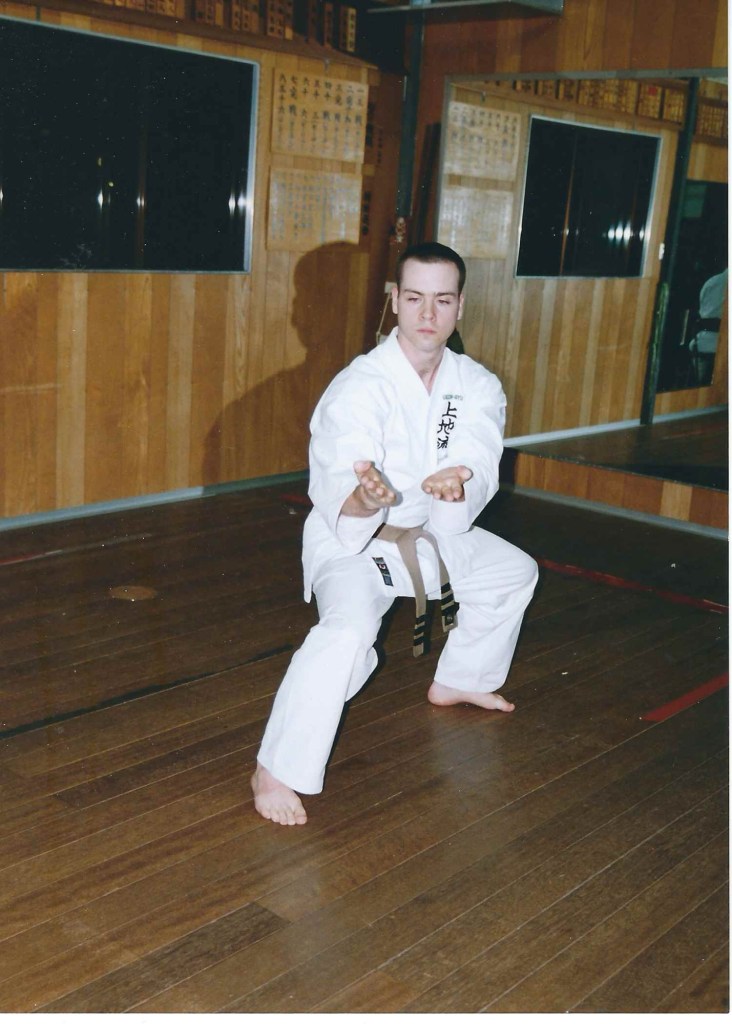
Flash back to 2001. I was a brown belt in Uechi-Ryu Okinawan karate. I had just turned 23 and we were planning Sensei’s next trip to Japan. I would be joining on this trip, which I expected to be a once in a lifetime trip. I still remember the thrill and excitement that first morning, despite the early hour, while we sat patiently in a small, rural airport to board a flight that would begin a bunny-hop towards Japan. Leaving a small community in Quebec named Mont-Joli, we landed in Quebec City, followed by Montreal and subsequently New York. We spent the night in Manhattan, then grabbed an international, 14-hour flight to Narita, Japan. We stayed there for a couple of days before grabbing another flight that would bring us to Naha, Okinawa. During our stay in Narita is when I found the tome that would change the game for me. You see, staying in just about any hotel, you’ll usually find a bible sitting in every bedside table. While it’s a very less prominent today than it was 50 years ago, it still happens quite a bit. Turns out, they do something quite similar in Japan, although with Buddhist books.
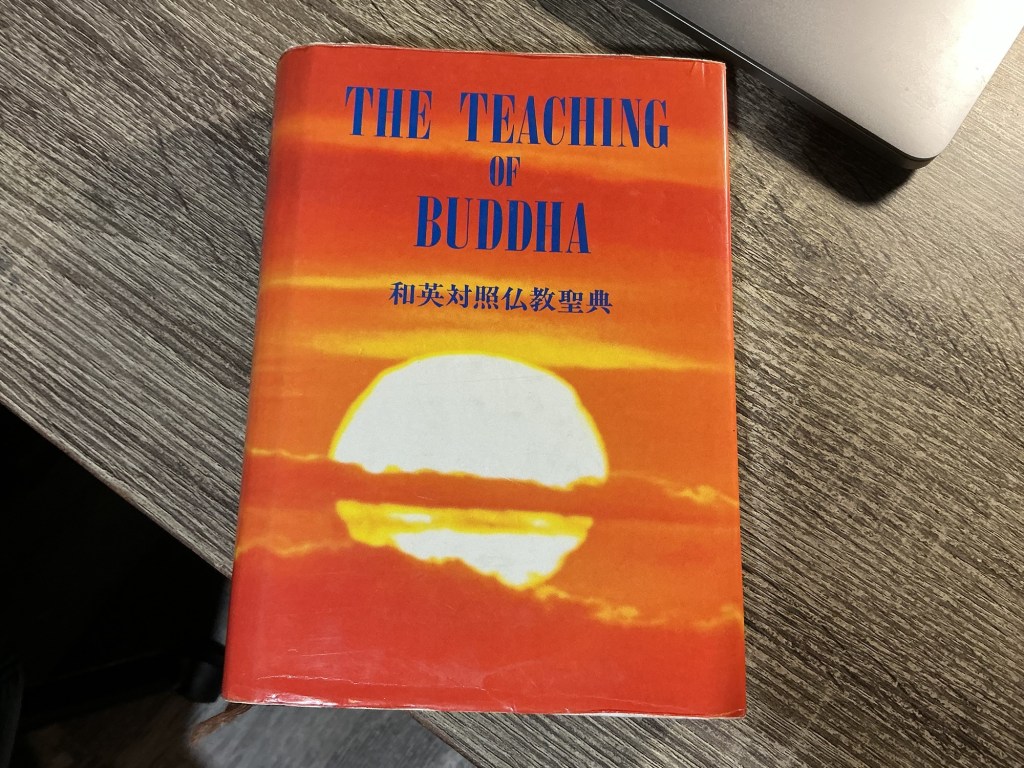
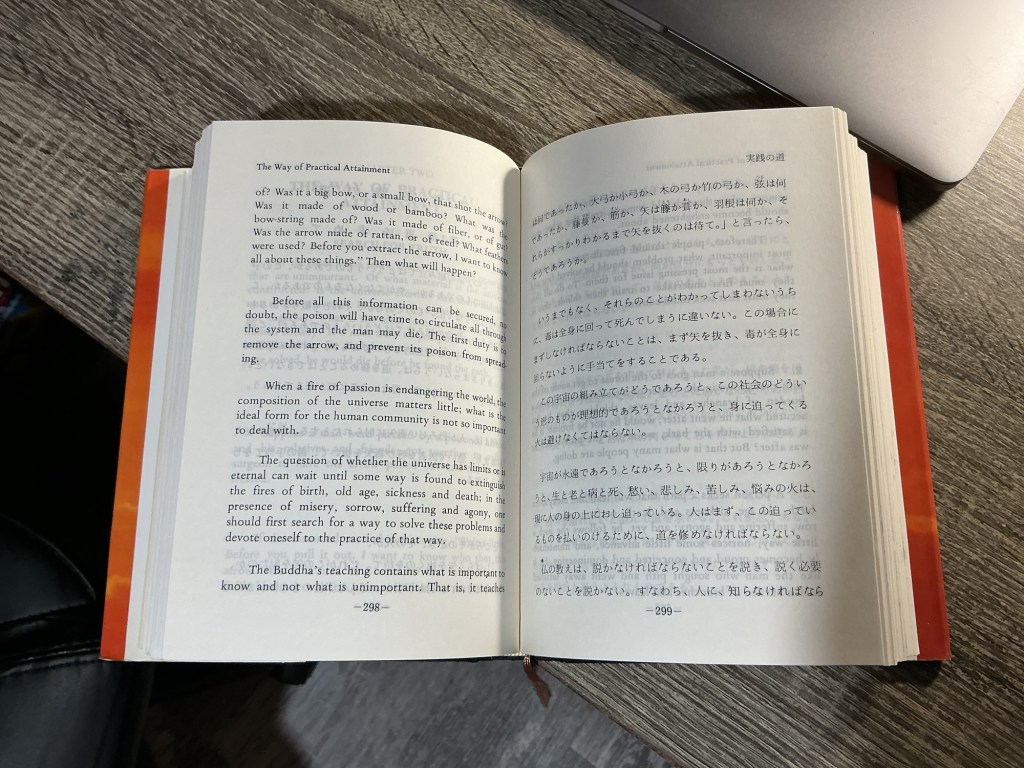
During our first night in Narita, which was in a traditional Japanese Inn, I was preparing for bed when I noticed the book from the photo above tucked away in the closet. I pulled it out and started it read. This had a fulsome history of how the Buddha came to be, the precepts, principles and guiding philosophies behind the practice. I was entranced and couldn’t put the damn thing down. Sensei commented on a number of occasions that I didn’t travel to the other side of the world to read. And While he may have been right, I was hooked. When we were due to check out of the hotel and travel to Okinawa, I was convinced I needed it retain this book and bring it back to Canada. Not wanting to leave Japan as a thief (believe or not, you aren’t ACTUALLY supposed to keep bibles you find in hotel rooms), I went to the front reception to negotiate the purchase of the book from the owner of the inn. One of our teammates who had travelled there with us, who was not quite as well versed on the customs as he should have been, imposed a monetary tip on the innkeeper for the breakfast he had served us that morning.
This is a great disrespect in Japan, where they believe only in getting paid for the actual work they perform. Giving gratuities is considered rude, bordering on the insulting. Not having learned any of the language, my colleague didn’t seem to understand that he was offending the innkeeper, and walked away smiling, thinking he had done something nice. When I asked to purchase the book and asked how much it would cost, I was puzzled by the innkeeper’s response of, “Please accept it as a gift and keep it.” I didn’t understand at the time but I shrugged and thanked him profusely and carried on. It wouldn’t be until days later that Sensei would explain that the innkeeper gave me the big to save face after being forced to keep money he had not earned. Craziness. But I get it. In any event, that’s how I got my hands on the best book on Buddhism that I had found up to that point, and ever since. I’ve read through the damn thing several times, and every time I pick it up, it brings back fond memories of my travels overseas.
But what this post is about, is an interaction I recently had with a colleague at work with regard to this book. Although I don’t spend my time screaming it from a mountaintop, when someone does ask about karate and about some of my observances, I do bring up Buddhism. For the most part, I get responses like, “Oh. Cool.” Or, “Sounds neat.” But no one ever shows any measurable interest beyond that. It isn’t until this work colleague asked and I brought up my meditation and calming practices and where I had acquired them, that this book was brought up. The colleague was completely fascinated and wanted to know if they could borrow the book to read through it. Especially given that it’s written half in Kanji, they really wanted to see it. I told them I would see about letting them have a look at it but wasn’t sure if I could bring myself to hand it over, after how long I’d had it and what the book represented to me.
So, I did one better. I located a provider in Japan and obtained a copy. Once shipped to my home, I let the colleague know that it would be waiting in my office and she could retrieve it at her convenience. It arrived on a Monday and she attended the office on Wednesday to pick it up. For context, this colleague works 100% remotely, so her trips to the office are fairly rare. Excited to start reading, she even asked me to sign the inner cover of the book, convinced that she would never part with it. It felt nice, sharing that little piece of myself with someone else who showed an active interest. It’s not a part of myself that I share often, except in my writing. But it reminded me that spreading a bit of light should be a part of everyone’s life, no matter how small or momentary. Doing so goes a long way towards cumulatively reducing the suffering in the world. And in the end, that’s really all we can hope to do with our little slices of time in this life. Food for thought… ☯️
I guess today’s title is a bit misleading. After all, I can’t envision a scenario where having a life-long autoimmune condition would ever be anything but dark. In retrospect, I can’t genuinely say that my life has been absolutely horrible. After all, there have been plenty of instances where my condition has helped me grow, develop and mature faster, given the requirements to stay alive and healthy. It’s given me a sort of perseverance that many don’t have, especially in the face of today’s modern issues. But I would be lying if I said the hard parts aren’t, well… HARD. Throughout my youth especially, I’ve faced a number of obstacles that threatened my life due to Type-1 Diabetes, starting with the actual event that led to my diagnosis, the subsequent coma events in the years that followed, all the way up to my vision and organ issues (most of which I’ve fought my way back from and am maintaining a healthy front).
So, what’s left? Well, in today’s post, I’ll light out some of the most prominent and misunderstood obstacles that I face on a daily basis. This is one of those posts, and I can’t believe I haven’t had to say this in quite some time, that I feel obligated to remind anyone reading that I am not a doctor, I don’t work, nor do I have education as a health professional and the information contained in this post is strictly my opinion, mixed with a minty hint of some materials that I may have found through peer-reviewed medical journals or websites. So, take what you read with grain of salt and bear in mind that not ALL Type-1 Diabetics are necessarily dealing with the same issues that I am (although I can’t imagine that most are not). So, read away and dive into the issues that I deal with on a daily basis…
Constant Medical Appointments: This one is pretty straightforward and should come as no surprise to anyone. During my childhood, medical appointments were something I viewed as a bit of an inconvenience rather than an obligation. And sometimes, it was actually fun. After all, what kid doesn’t enjoy getting out of school early, even if it’s to hit up the doctor’s office? This was usually followed by convincing my mother that there wasn’t enough time lefty o the day to make it worth going back to class, which meant I could go home and chill. As an adult though, it becomes a little more complicated. Working a significantly busy job, working around all my medical needs it becomes significantly challenging. I usually have outstanding appointments schedule with helps practitioners that include but are not limited to, my endocrinologist, whom I see every six months, my optometrist once a year, ophthalmologist every sixteen weeks for eye injections, dentist for proper gum health to prevent cardiac issues and the occasional visit to my family doctor (although my echo usually refills all my prescriptions for me). Over the years, I’ve adopted a policy of full disclosure of personal observation to my boss. Otherwise, it can become a bit tricky trying to explain WHY I’m always taking medical absences from work. In short, one does not inherently have to. But it does leave a bit of a spurt taste in one’s employer’s mouth and can affect future opportunities. But in short, it makes navigating my schedule on a month-to-month basis extremely difficult.
The Constant Fatigue: I’m always fuckin’ tired. I can’t overstate this aspect enough. Even when my meds, blood sugars and fitness supplements are well balanced and I have the energy to hammer through my day, exercise and play with my kids, my body is still effectively telling me to stop and lie down, take it easy and rest. Some of this comes with age, of course (I happen to be in my late forties, after all). But an aspect that people tend not to realize is that my body is constantly fighting; fighting blood sugars levels, fighting to stay healthy, fighting ME and all the efforts I put in to stay alive. This can lead to some awkward situations where I’ve found myself cancelling plans because I’m just too beat, deciding that binge-watching a show is preferable to going out to do something and in many cases, I hit the pillow significantly early in the evening, which often takes away time with my wife and children. That sucks on multiple levels but I usually lose the internal battle and opt for increased sleep as opposed to being bitchy, tired and cranky with my family. I do enough of that as it is. But in the past, I’ve damaged friendships and have lost opportunities because I couldn’t muster the energy to respond, which really sucks.
The Double Standard: This one is a bit tougher to lay out, because in most respects, I have no choice. One of the more difficult aspects of Type-1 Diabetes has been becoming a father. Taylor becoming a parent is normally viewed as a joyous thing, and it certainly has been in my case, it does come with its fair share of challenges. Explaining Diabetes to a child is already a challenge in and of itself. But when your trouble to teach your child to eat healthy and that no, he can’t eat snacks and junk food all day, it becomes difficult when he sees your shoveling Skittles down your throat to treat a low. Then comes the obvious question: “If I’m not allowed to have candy until I’ve eaten dinner, why can you?” From a child’s perspective, this can seem like an obvious double standard; one that isn’t satisfied by an easy “because I’m the parent.” At least with my kids, that shit doesn’t fly. But it can make things difficult, especially since some children will take it upon themselves to revenge the situation outside of the rules. I’ve lost count of how many times I’ve suffered low blood sugar and staggered over to my home office, only to find that my candy stash has been pilfered by one and/or both of my sons. This is not only something disciplinary that I would need to address but it can be inherently dangerous for me. I remember the one night, when I awoke to blood sugars hitting 3.2 mmol/L. I stumbled downstairs and found my box of Halloween candy was nearly empty. I didn’t have enough to properly repeat my low and hoping myself digging through cupboards at 2 in the morning to find something else. Some speeches and punishments may or may not have been doled out the diluting day.
Increased Preparation and Planning: This one is a personal pet peeve but one that I have to deal with on a daily basis. When you have Type-1 Diabetes, you always need to plan ahead and pack bags, prepare and anticipate all T1D contingencies, even if you’re just running errands at your local corner store. I remember an instance last fall, when I ran out to the mall to hit up a store for a couple of items. I left the house with my blood sugars sitting at 6.2 mmol/L. By the time I had reached the mall, I started to feel off and checked my pump, which displayed 3.5 mmol/L. Are you KIDDING me??? It was a five minute drive! Since I hadn’t had any caffeine at that point, I opted for a normal, sugared energy drink. Killed two birds with one stone. Problematically, it took some time to take effect, during which time I was parked on a bench and couldn’t do much but let my wife know I would be delayed in getting home. It demonstrates an important aspect of living with T1D, that even the shortest trips require certain items to be brought along, including a blood glucose monitor in case one’s CGM fails and some fast-acting carbohydrates to treat any sudden lows. Don’t even get me started on long0distance travel! During my recent trip back to New Brunswick, I had to preplan how much insulin, how many infusion sets and reservoirs I would need, as well as ensuring I had fast-acting carbs to carry with me onto the plane. Nothing worse than being at 30,000 feet and suffering a low, with the flight attendants unavailable to bring you a can of Coke to help. We have a trip to see family coming this weekend and although I’ll only be gone for a coupe of nights and only a few hours away, I’ll have to ensure I’m prepared for any contingencies. A larger obstacle is being in a smaller community where the limited pharmacy presence can result in there being nothing available if I’ve forgotten something.
So, there it is, folks! Just a short list, despite the long read, of some of the “unseen” obstacles that someone living with Type-1 Diabetes will usually have to contend with. For myself, some of these obligations have helped me develop my overall organizational skills, which have carried pump my professional life, which is good. Cause and effect, right? And nothing teaches you better than something that could potentially be life-threatening if you forget. I’ve always quipped that I would survive no longer than a couple of weeks in the event of a zombie apocalypse. This is mostly because once the insulin runs out, I’d be toast, no matter how skilled at survival I may be. But jokes aside, this would certainly apply to any significant disaster. I remember back in the early 2000’s when New Brunswick had a number of long-trucker strikes. Setting aside my personal disapproval of striking as a general action and the opinions that this would bring forth, some of these strike were long enough that medical supply chains suffered and on one occasion, my supply of insulin ran dangerously low, with no alternative.
There’s a significant amount of planning, anticipating and organizing that comes with managing and living with Type-1 Diabetes. Especially if one expects to maintain and extend their life expectancy beyond the usual 20-year shorter lifespan average for folks with my condition. When I look at some of my friends and associates who also live with T1D, I believe I’m well ahead of the curve. But that doesn’t mean that every day isn’t an ongoing challenge that others don’t see. And that, in and of itself, is exhausting and tiring in ways I can’t possibly explain. All part of the great journey of life. Good for thought… ☯️
There is suffering in life. This is one of the key concepts in Buddhism , that an important goal in life is the reduction and elimination of suffering. This is generally in the pursuit of peace, although many don’t do much to try and work towards that goal. Speaking pragmatically, the elimination of suffering and promotion of peace within one’s daily life has a number of important health and mental wellness benefits attached, some of which we’ll try and address here a bit. For myself, I had the opportunity to go through a number of different iterations of how I’ve approached life, starting in my youth. As a child, I was reasonably withdrawn, solitary and shy. I would avoid most people and keep to myself. A lot of this came as a result of all the attention being placed on my brother, who was constantly ill. I can’t fault him for that but the result of such a childhood is that I grew up learning to stay silent, pushing down my worries and concerns and making as few waves as possible.
The result of that approach was the development of stress-related stomach issues, along with a ulcer in my gut. Not a great way for a preteen to be growing up. It didn’t take me long to recognize, even at that age, that I had to make a change. And it wasn’t long after that, that I began my martial arts journey. I’m the whole, I had a lot of benefits working in my favor. Our household growing up was always a quiet one. Despite how loud my mother and I could be, it was pretty easy to step up to an open window and enjoy the sounds of life without hindrance from the inside. It was at this age that I behave looking into meditation, humans books on the topic, as well as yoga and some medical texts that could help, in my local town library. That probably dates me a bit, considering there was no access to the internet at that time and all of my research was limited by the VERY limited resources of my local library. But it got me started.
As I grew into my teen years, a combination of hormones and increased level of fitness and martial arts skill changed me, and not necessarily for the better. I became angry, frustrated with everyone and everything, and prone to swing first and ask questions later. I was able to recognize this in myself as an issue and dove deep into my meditation and it was at this point that I began studying Buddhism. I always use the term “studying,” because it was in fact as study, to examine and learn as much as I could about the peace-promotions faith that nearly half a billion people worldwide follow. This allowed me to begin learning how to constructively focus that aggressive energy, to use it in constructive ways and to keep from bottling it all up and making myself sick with it. The result was a much greater control over what affected my day. I was able to keep from sweating the small stuff and live my daily life without feeling like I was on the icing of war all the time. The improvement was noticeable in my entourage, as well.
However, a lot of that changed when life choices that hindered routine and consistency came into play. For example, becoming a police officer certainly went a long away toward shattering my calm veneer. You want something that’ll crack your calm? Try working a career where you always see both the light side and dark side of humanity. That’ll put the itching powder in your boxers, let em tell you. This was combined with becoming a new parent. In 2014, we became parents to my eldest son. Nothing like spending every waking moment with a tiny human that does nothing but eat, sleep, cry and shit for 24 straight hours to put a chink in your armor AND your daily routine. I reached a point where meditation and calming myself with the external tools I had previously enjoyed were no longer possible. Ever try meditating when a baby starts crawling into your lap? Kind of tends to distract you. In both good and bad ways. But it simply means that one starts suppressing the negative instead of channelling or addressing it. And that’s where the problems begin.
Back in 2021, and with the continuing pebble in the shoe that was the COVID-19 pandemic, I found myself sitting at home, on leave from work due to my Type-1 Diabetes and contemplating life in all of its aspects. While contemplation can be good, there’s also the danger of one’s thought process going in the wrong direction. Take hands and all that. But for me, despite finding new employment and moving on to a cleaner environment than the one I had been accustomed to as a police officer, I slipped back into my persona of anger and frustration. Work bothered me. The drive home bothered me. Everyone was an idiot, everyone was in my way, everyone was saying or doing something to PISS ME OFF… It snuck up on me that this storm in my soul had been brewing for a few years. I suddenly came to realized that it wasn’t healthy or productive for me to be in a bad mood all the time and angry at the world. After all, if I’m being realistic with myself, the world cares little about my feelings and won’t change because I’m bothered. It would be up to me to make the change.
One of the big things that I started to work on was burning off excess energy. In recent months, I’ve come home and my first step when getting home is to change and go hit the punching bag for at least 30 minutes. Provided my blood sugars allow it, I try to follow that up with another 30 minutes but on the bike. You have no idea how well you sleep and how much aggression you burn off til a solid, 60-minutes of sweaty, exhausting exercise. I’ve come to discover that maintaining this routine, besides for the obvious purpose of working out and maintaining one’s health, helps me to sleep better, which means I’m better rested and in turn, I’m less cranky and Waterbury less aggressive and angry at everything. When you start to let go of all that anger, it’s amazing how easy it is to make one’s way through the day with calm and proper determination. And the more you stay calm and quit sweating the small stuff, the easier life gets. And in reality, that’s genuine peace; to live happy, with one’s family and within one’s own circle, without the messy noise that comes from the hustle and bustle of modern, everyday life. Good for thought…☯️
Most people, especially in the western world, consider obtaining a black belt as being the ultimate goal for a martial artist. While it certainly is ONE of the goals to aspire to, it’s far from the end of the journey and there are several goals that should come before, during and after grading for shodan. But thanks to mainstream media and the commercialization of martial arts, people think black is the finish line and you become an expert. And once you’re there, you’ve completed your journey. In a world where tons of McDojo’s will allow you to promote to black belt simply by paying the fees, not only is this perspective incredibly inaccurate, but it’s a dishonor to the style and the rank itself, as well as to the actual, dedicated senseis that work towards training and developing students who are committed to the art and not just pushing through those who want the prestige of the belt around their waist. And now that I’ve finished with that rambling, long-winded sentence, I’ll step down off my soapbox and get to the point of today’s post: can a student actually fail a belt test?
Training as a green belt
I recently read a post of social media that raised this important question and a lot of good arguments came out of it, which I’ll cover off here. I tend to be cautious when I write a post based off of someone else’s. After all, i want to be fair and clear that this idea was prompted AS A RESULT of someone else’s writing and opinion and not a fresh useable that I came up with myself. That being said, I DO have a lot of my own opinions on this topic, and they hit close to home. When I started karate 36 years ago (holy shit, eh?), I walked into the dojo with a white belt around my waist. Personally, I didn’t care about the uniform, the color of the belt or any of the prestige that would come from training in karatedo. Even when I started to climb some of the initial ranks, i was never one to brag or boast that i was training in the martial arts. To me, there was no point; I was training to improve my health, learn to defend myself and all around save my own life. Granted, not everyone has that same perspective. Some folks love to puff out their chest and talk about their belt, their proficiency or their status within a dojo. None of this ever made a difference to me.
Now, it’s important that you don’t get me wrong, here. I was dedicated, committed and proud of every belt I achieved. But that pride is reserved to a personal space where I can look at old photos, such as the one above, and the belts themselves (yes, I still have them all) and reminisce about the times when I trained through blood, sweat and tears, the sacrifices I made to get to where I am in my karate journey and the friends and relationships I’ve lost because I wouldn’t compromise that. In my world, it was always more important to stay humble since you never know what someone else can teach you. I’m a black belt? Sure, but I can still learn from you. There’s always something more to learn. But getting back to the belt tests, I don’t understand the concept of someone potentially NOT passing their belt test. Many have commented that if a sensor is worth their merit, their students wouldn’t even be put up for testing until they’re ready to pass. Unfortunately, that isn’t the purpose of a test, nor is it realistic.
Four generations of student in one photo
I can only speak to my own experience and many dojos have different perspectives in this area. sent I was a white belt, I was all in and committed. I would pass up opportunities to hang out with friends, my high school girlfriend and I broke up (more than once) because I’d go hit up class instead of sticking around and I preferred to stay home and practice kata instead of going out and partying and drinking like most people my age. I climbed the kyu ladder and made my way to a level where it came time for me to test for my form belt. Now at this stage, given that it WAS my first change of belt color, my Sensei would usually be the one to determine when the student was ready to test. I won’t get into the specific of the test, given the importance of keeping such things within the dojo. If you want to know what grading for green belt is like, join a solid dojo and experience it. But when Sensei told me it was time to grade for gokyu (green belt), I was struck with equal parts anxiety and excitement. The prospect of wearing something other than white around my waist presented a curiosity that I hadn’t known I had.
But the anxiety was prominent, as well. What if I failed the test? What would it do to my confidence, my drive and my will to train above everything else? While I can easily and readily agree with those whose opinion indicates that a student shouldn’t be put up for grading until their ready, the post I ready made an extremely important distinction; there’s a difference between being ready to test and being ready to pass. While one may train diligently, nail down the skills, forms and techniques necessary for their next belt test, there is a big difference between training with your class in the dojo environment and testing for a belt by yourself with no one but Sensei watching your every move and step. For some, the nerves, stress and pressure that comes with such a test can prove to be too much and one can easily fuck up some key areas that may result in a failure of the test. For me, I had to steady myself and promise myself to give the same energy and enthusiasm during grading as I would have in the dojo. If I did my best and pushed as hard as I could, even if I didn’t pass, I would learn the areas that I needed in order to continue to progress.
Training in Okinawa as a brown belt
When I finally finished testing, I collapsed on the floor, exhausted and worn from four hours of intensive testing. And yes, you read that right. My green belt test was just shy of four hours long! When Sensei finally handed over my green belt and I wrapped it around my waist for the fire time, I felt a renewed sense of purpose to start learning my next forms, continue to develop my skills and maintain my health. I felt no inclination to go out and party, brag about my new rank or puff out my chest as a tough guy. But the lingering thought always sat in the back of my mind: what if I had failed the test? Turns out the answer was fairly straightforward; you don’t promote. You go back to the drawing board and continue training. While that can be a hard reality to deal with, it simply goes to prove that a student still has more work to accomplish. And at least in my dojo, the students were given the time and resources to develop and improve the areas that may have caused the failure. As long as they recognize that it’s only one piece in a much larger puzzle and that they’ll get their chance at that piece again, it should be a ‘no harm, no foul’ kind of scenario.
Turns out that in my dojo, while exceptionally rare, there were some who would fail their belt tests. I learned pretty quick that Sensei favored a more confidential environment where the test was not disclosed to the other students, nor was the result. Granted, passing meant you walked in with a different belt, so it was a difficult thing to hide. But in speaking with some who came back from a test with the same belt, they’d simply shrug and say they weren’t ready. So, what might be some of the reasons that someone WOULDN’T pass a belt grading? After all and in line with several popular opinions, if the sensei only schedules a test for a student ready to grade, why would they fail? Right? Maybe. But there can be a lot of underlying reasons. The first is what I discussed above. In many cases, the stress, anxiety and even fear of testing can throw a significant monkey wrench into one’s ability to be successful. We’re all prisoners of our own mind, after all. This can especially suck for someone who lacks the tools to overcome their own, internal anxieties.
Training as a black belt, with Sensei
And for some people, they simply lack the WILL. what I mean by this, is that some people are perfectly content to train and learn but have no interest in going through the rigorous demands of a belt test. Or worse, they walk into the grading thinking they’ve earned their place and rank and that the test of similes formality. Such students will rarely pass a belt test, if they just go through the motions without putting in the will and determination to push through. Senseis will usually see that and deem the student unready to step into the next belt level. Vanity and entitlement have no place in the dojo. And finally, some folks may simply shit the bed. After all, a test is a test is a test, right? And a person can be a ready as possible to test, have the skill and ability, practice efficiently and still walk out of that test having failed because they suddenly blanked on something, something they can’t remember, that may be integral to passing the test. Depending on the dojo you train in, of course.
At the end of the day, karatedo did not originally carry a belt system. Originally, it was a simple hierarchy; teach and student. It isn’t until later that belt grades were introduced as a way of determining someone’s seniority and skill level with a dojo. But it’s important to remember that it isn’t about the rank. It isn’t about the color of the belt around your waist. No matter what your reason for wanting to train, your time in the dojo has to be about dedication, commitment, discipline and hard work. Only then, can you truly learn the skills that are the martial arts in the manner it was intended. And only then, will you become a karateka who will carry and show actual skill, instead of puffing out your chest and acting like a tough guy because you have a black belt around your waist. That belt won’t stop a threat against you. Only diligent training and the antiseptic of actual skill will do that for you. Food for thought… ☯️
Parenthood is a challenging part of life. I’ve yet to meet a parent who can say with any firm honesty that raising children is smooth sailing with no inherent concerns. Even if you have a child who happens to be well-behaved and eats everything placed in front of them, there are still challenges that can lend some difficulties to the overall daily operation of one’s household. I happen to have two boys, 11 and 6 years old, respectively. And while I absolutely love them to the moon and back and would protect them with my very essence, they certainly do their fair share of seeing how easily they can crack my zen-like veneer. But setting that aside, and recognizing that there is no manual on how to properly raise one’s children, one of the unique obstacles I’ve faced for more than the past stable, is how to address and deal with Type-1 Diabetes with my sons.
All children, even the best-behaved ones, will eventually get into some shenanigans, take things they didn’t ask for, cause unintentional damage to things within the home (at least one HOPES it’s unintentional) and cause issues in areas that a first time parent may not think of. For myself, my issues came in when I started on my very first insulin pump. When this happened, my firstborn son was barely past a year old. While pump training and adapting to its use came easily enough for me, infants have a tendency of grabbing at everything that’s within reach. This is normal for them, and part of their sensory development and growth. However, it can be chaotic as it relates to grabbing pump tubing and playing tug of war with the infusion set injected into one’s stomach. It took me a significantly amount of time to strategically place myself so that my pump, the tubing and other components were safely out of my baby’s reach. Obviously, he can’t be faulted for his reflexive instincts, but it certainly makes things difficult.
I remember the one time, when Nathan was about two years old and we were rolling around on the floor and wrestling. He was giggling and we were having just a grand ol’ time. That is, until his little hands wrapped tightly around my pump tubing and I happened to be moving away from him right when he closed his fist. The infusion set tore free of my abdomen, leaving me to expel a sound from my mouth that I’m almost certain neighborhood dogs were able to hear. He immediately released his grip and started crying, Hanna been startled by my reaction. I writhed on the floor momentarily, uncertain which hurt more; the adhesive ripping away at my tummy hair or the infusion tube being ripped from my abdomen and the resulting blood that poured out for minutes afterwards. It was a definite lesson for me, in the management of my equipment around small children. IN the couple of years that followed, I educated my son on the purpose of the device on my abdomen, how it helped to keep me alive and healthy, and the importance of never touching it or fooling around with it.
I ended up going through all the same issues with my second son, who was born a few years later. I guess at least that my children’s are consistent. But one significant problem is keeping any fast-actions carbohydrates anywhere in the house. For the most part and for me specifically, the best thing is either jellybeans or Skittles. Sometimes some gummy candies will work as well, but jelly beans or Skittles seem to act almost immediately, where I can wolf down a dozen jellybeans and be back in the game within fifteen minutes. Same thing with Skittles. Pedant juice and some of the more traditional “give it to a Diabetic if they’re low” options have never worked for me quite as efficiently. And some of the carbohydrate capsules and gels you can buy at most pharmacies carry an increased cost that just isn’t worth it, when I can get a huge bag of jellybeans for about $10 and it lasts for weeks, instead of one or two episodes. But I digress…
The issue is that if small children see their parents wolfing down candy, they begin to ask why they can’t wolf down candy, as well. This is also a normal reaction and instinct, since most small children will moving the behavior of the parent. And the consumption of candy is obviously no exception. It can be hard for a child, who may not have eaten their meal yet, to ask why daddy gets to eat jellybeans but he can’t. It’s a valid question but trying to explain that I’m eating candy so I won’t die only serves to have the kid also believe they need candy to stay alive. And this can lead to some unexpected consequences. The best example is something that happened about six years ago, which changed my approach to storing, keeping and ensuring my candy is available to me for when I really need it.
I’m a particular night, when my first son was about four or five years old, he was wandering the house, playing quietly and doing his own thing. His mother and I were watching television and had essentially tuned out, since he was entertaining himself, allegedly in his room. After a while, we realized we could no longer hear him playing. Ever see those jokes online about how silence is the worst thing to hear when you have small children? That’s no joke. We wandered the hallways of our home looking for him but couldn’t locate him anywhere. We were calling out and receiving no response, which is obviously triggering to any parent. The doors or the house were still locked, so he hadn’t gone outside. I finally found him hunkered underneath my bed on his stomach, just absolutely going to town, wolfing down as many jellybeans as he could fit in his mouth.
He had gotten through quite a bit of the tub, too, which as a side note was impressive. I experienced the same thing with the youngest when he was about the same age, which was only about a year or two ago. I usually replenish my fast-acting carbs a couple of times a month. I’m this occasion, it was close to Halloween and sometimes those Halloween-sized packets are just perfect. So, I bought myself a box of 100 treats. I left it down by the desk of my home office, having long ago abandoned keeping them by the bed. In most circumstances and if I wake up during the night with a low, I would prefer to go down to my home office to consumer, rather than unnecessarily waking my wife. But I came home from work the one day, coming in at action 3.4 mmol/L and looking forward to scarfing down some candy to raise it up. I discovered the box nearly empty, which compromised my ability to get my blood sugar up quickly.
Once I had treated the low, I started investigating and found dozens of wrappers hidden among our storage totes in the basement. I won’t get into the details but it was determined and clear that the youngest had helped himself and pilfered most of my supply. Once again, I had to have an in-depth conversation about not touching daddy’s candy as it was needed to help keep him alive. Only this time, it was with the youngest. Now, I’ve obtained a small tool box, of all things, that allows me to place a lock on it. As sad as it sounds, I had to start locking my candy over recent years to ensure it isn’t snuck away by little hands. I can’t imagine what would be the result, if my fast-acting carbs were suddenly just not available. I’d probably make it through by eating straight granulated sugar, but it wouldn’t be ideal.
Another distinct complication is Diabetic fatigue. Whether from fluctuating blood sugars, fighting a high and trying to bring it down or a host of other reasons directly tied to Type-1, the reality is that in most cases, one’s energy level simply isn’t there. And that sucks! There’s nothing worse than having a smiling little face ask you to play and you have to tell him that you can’t because you’re “too tired.” To little ears, understanding simply isn’t there and disappointment sets in quickly. In most cases, a kid eventually stops asking because they assume you’ll say no. Then actually trying to do something with them becomes all the more difficult because THEY will start saying no. It’s a painful cycle. Luckily, I have my meds, supplements and workout routine somewhat down pat, which allows me to enjoy a level of energy I haven’t had for the past few years. But my oldest is at the age where all he wants to do is hide out in his room. Luckily, the youngest is still engaged and shows promise as he wants to learn karate.
The last concern for a Diabetic daddy, is a possible genetic component. Because Type-1 Diabetes is effectively an immune disorder targeting your body insulin-carrying beta cells, there’s a genetic component involved. One of my biggest fears is that my sons, or their children after them, would have to live through all the difficulties and obstacles that I’ve experienced in my life. Considering I’ve been comas, had stomach ulcers and a variety of visual complications as a result or Type-1 Diabetes, I can’t think of a single parent who wouldn’t be concerned about this altering passed on to their children. Luckily, both my sons have been tested and have come out clear and clean. Granted, even if it hasn’t taken hold yet, the possibility of becoming Diabetic can still exist, up until the early teen years. My oldest is essentially in the clear, but I’m still watching my youngest pretty closely for some telltale signs that he may be developing recognizable symptoms.
So, that’s it, folks! The only thing more challenging than being a modern-day parent, is being a modern-day parent trying to navigate Type-1 Diabetes with young children. There are plenty of other challenges that come as a result of my condition. But these are just the most prominent that I can think of, based on the past decade. It hasn’t always been easy but I’ve muddled through. Regardless on how great a challenge parenting can be, I saw something online a while back that got me thinking. Basically, it read that when the writer was a kid, he’d look at his father and assume he knew everything and could do everything. Now that he’s reached his father’s age, he realizes that his dad knew nothing, and was making a lot of it up as he went along. That’s kind o delay I’m learning now. While my sons come to me with questions, problems and curiosities of life, thinking that I have all the answers, there is no manual. No playbook. All we can do is our best and help them become the best people they can be. And not become Diabetic. That’s a pretty important goal. Food for thought…☯️
It’s a dark, warm morning. The alarm blares loudly at 3 am, shaking me out of a fitful sleep and summons me to begin the routine I require before making my way to the airport to start the first leg of the my trip home. I shower, shave and pack my meager backpack as best I can, seeing that there are a few few snack and drink items I had purchased at my arrival on Sunday that I won’t be able to bring onto the aircraft. Always loathe to waste food to money, I hesitate as I leave the items behind, cognizant that they wouldn’t‘ make it past the security check in. My last energy drink, which I cracked open as soon as the alarm went off, will be fully consumed before I check in. I step out into the morning’s latent heat, which surprises me a little, since the sun’s not up. But it’s already 18 degrees Celsius and the local forecast promises a hot day with minimal clouds. There should be no inherent issues with my initial flight out of New Brunswick. Let the shit show begin…
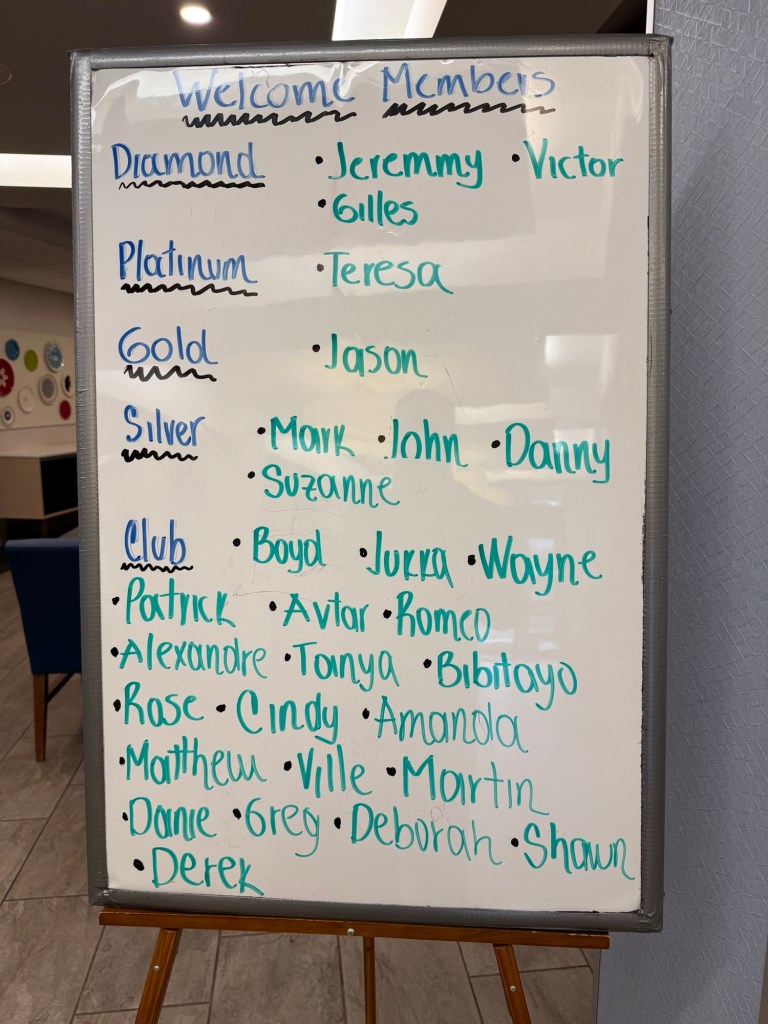
Second to last name from the bottom, but it’s always nice to be recognized.
My travels of the previous day went by relatively easily. I travelled down to Bathurst to visit Sensei’s son Guillaume using the old highway, which takes a little over an hour to drive through, versus the highway which would have only taken forty minutes. But when visiting a Maritime province, part of the journey is enjoying as much of the ocean as one can. Hence, I drove along the coastal line. The houses, rolling grass hills and open ocean were sights to behold. I sang pleasantly along with the music in my car, content on the moment and trying not to dwell on the long day I would endure tomorrow. As I reached Bathurst, I wandered out to a small place called Middle River, which is where Guillaume resides. We enjoyed some good conversation, a few laughs and memories, and even discussed our recent 30-year high school reunion, which neither of us attended. Given that we chatted for almost two hours and it was already 3 o’clock in the afternoon, I got back on the road, fervently aware that I still had a couple of hours of tetanus time ahead of me.
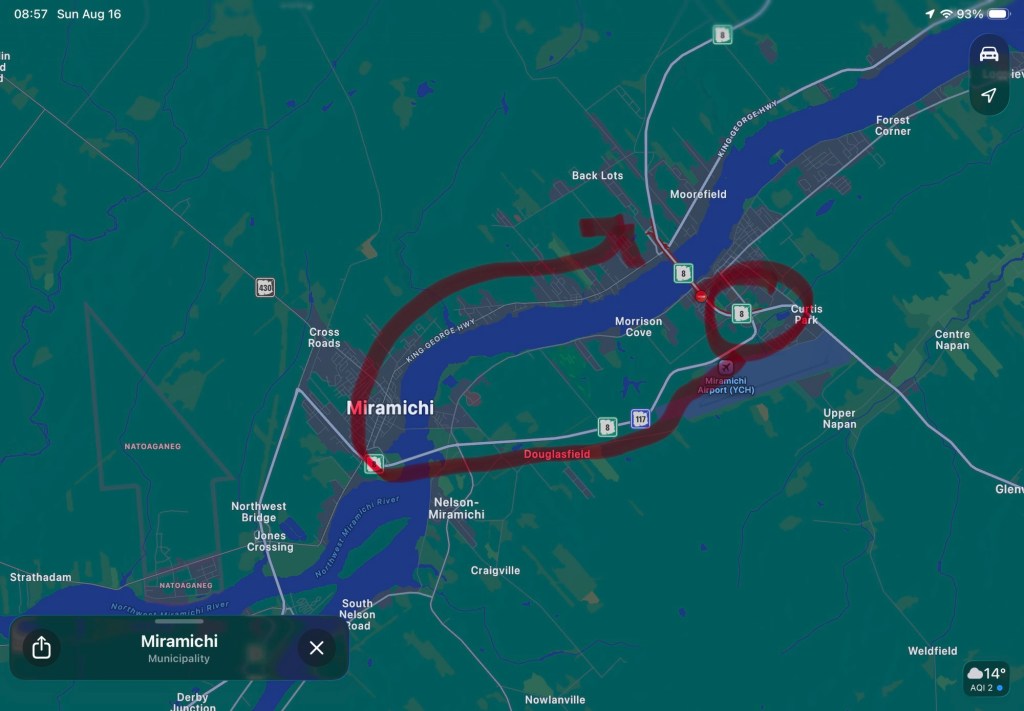
I hammered down the highway in an attempt to make the best time to Moncton that I could. Sure, I wasn’t going anywhere once I got there and would mainly be hitting up the hotel and crashing. But I was very aware of the 40-minute detour I would encounter in Miramichi as a result of the Centennial bridge closure, which would require me to cut westward then come across a causeway bridge. This was the only other access through the area, so ALL traffic was diverted to this location. It was an absolute nightmare. I based the forty minutes delay on my arrival on Sunday, forgetting the detail that it was 9 pm when I drove through. This time, it was about 4:30 in the afternoon on a weekday, and many people were already commuting home from work. My the time I cleared the bridge and got back on the main highway, I had lost over an hour. Tired and frustrated, I stopped at gas station along the main drag and managed to find two slices of meat pizza and a bottle of soda for only $6. Unaware of when I had ever seen such a cheap meal option, I pounced. I got back on the road and ate my pizza in silence.
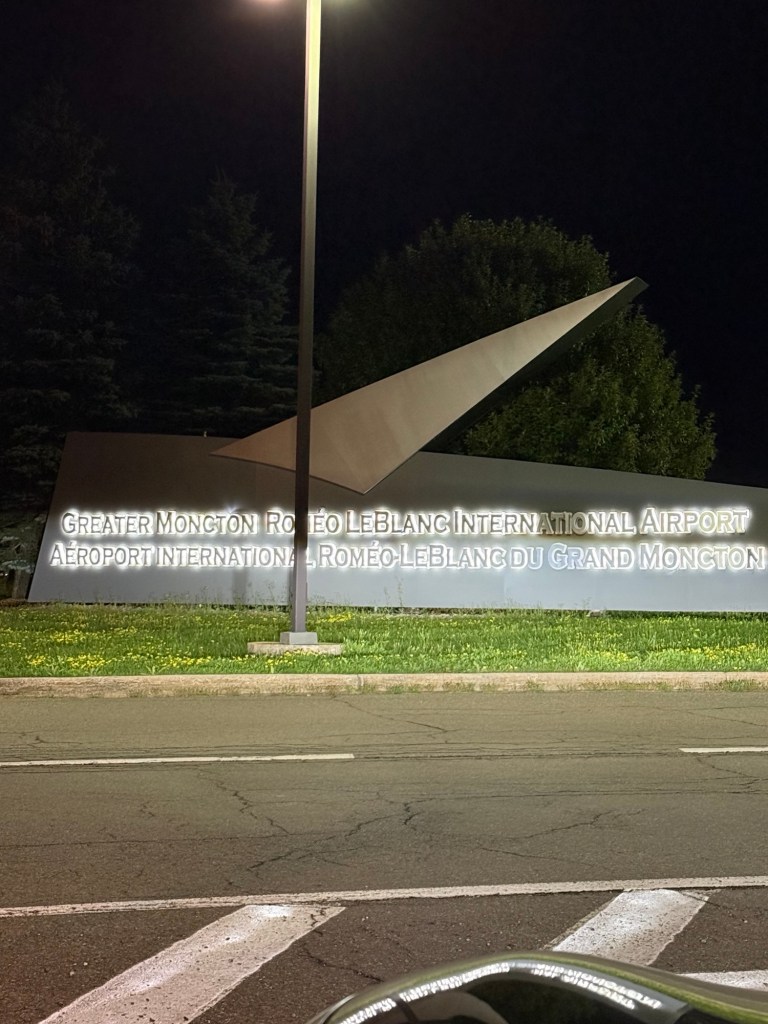
Moncton Airport
I got to Moncton relatively without incident and decided to get a leg up on the evening by filling the tinsel car’s gas tank now, as opposed to trying to find an open gas station at 3 in the morning. Besides an initial misunderstanding at the first gas station over requiring that I pay before I pump, which I totally understand having been a police officer, I got the tank filled and made my way to the hotel. Of, right! I should mention that the misunderstanding resulted in the police being called on me. But i cleared that up pretty damned quick. That’s a story for another post, since this one will be long enough without those details. I got into the room and laid out the clothing I would wear and organized the toiletries, which would also be left behind once I showered. At about 8:30 yesterday evening, I laid my head down for the last sleep in New Brunswick for the trip. Given the importance of being able to wake up alert and ready to move with the alarm, I opted out of my evening supplement, which usually encourages sleep, as well as the daily CBD gummy I usually take to help sleep through the vast kaleidoscope of PTSD nightmares I usually get.
Because I skipped all things that help with sleep, I only fell asleep around 10:45, which was much later than I ad planned. As a result, I barely got four hours of sleep when the alarm shook me back to consciousness. In recent years, I’ve always made a point of starting my morning off slowly, calmly, and at a relaxed pace. This has been an integral step towards maintaining my physical and mental wellbeing, and has served me well. Given the importance of not being late, this morning was different. I bolted out of bed, cracked a can of energy drink, slugged a few deep drinks and jumped into a hot shower. The warmth of the water beckoned me to return to the bed, curl back up and fly another day. But i had already been away from my family for too long and couldn’t miss this flight. Plus, given the way airlines tend to behave in recent years, I couldn’t risk losing the money on this ticket and being unable to reschedule. So, here I am.
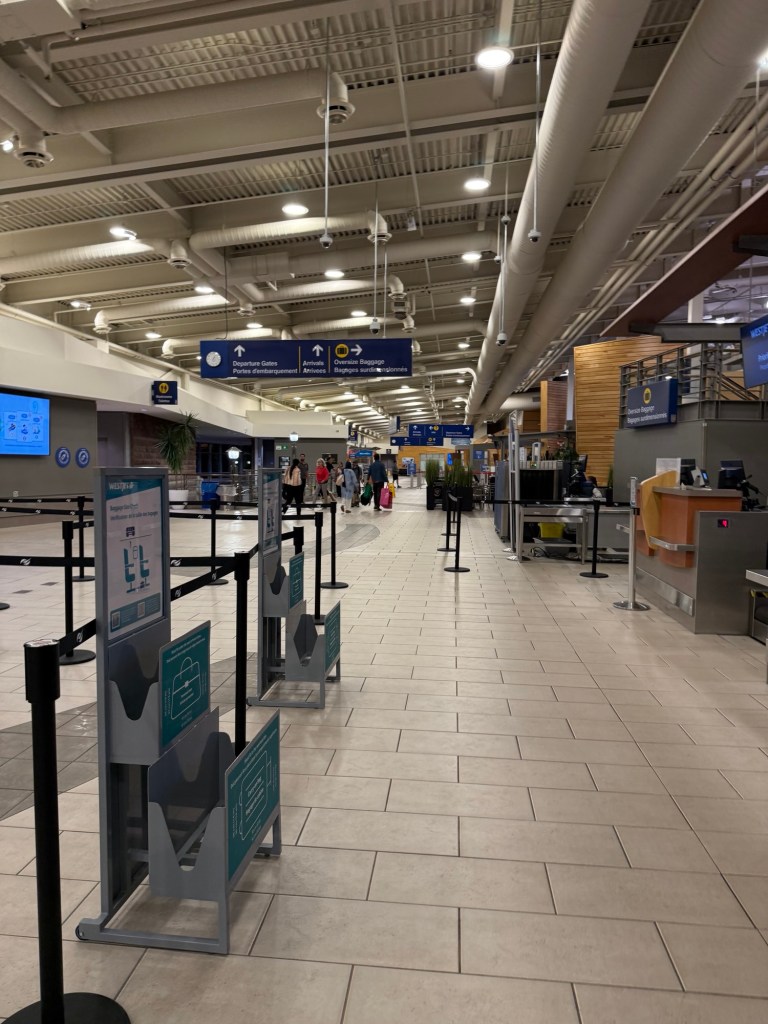
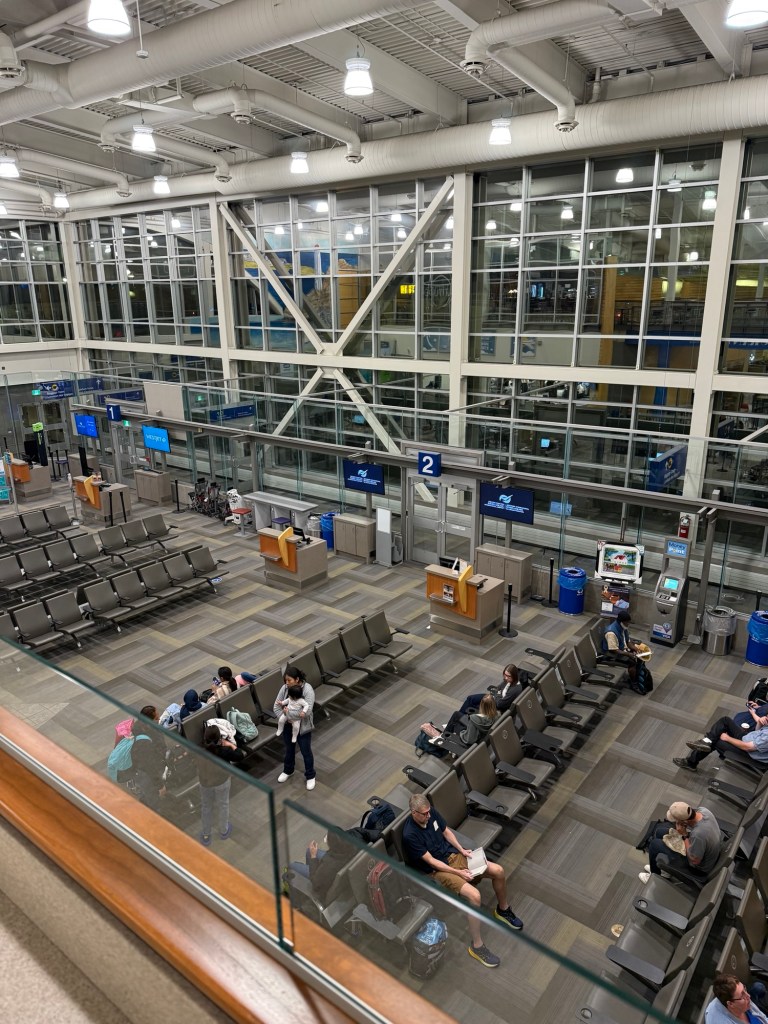
Boarding passes? Check! In to security to get felt up…The quiet calm of a small “International” airport
there were only a few people waiting to check in and the security line was quite short. So, I got into the secure area where my gate was located quite quickly. Looking at all the time slots for everything, I was suddenly quite glad I came in as early as I did. Despite the fact my flight only departs at 6:05 on my itinerary, my boarding pass showed a boarding time of 4:50, with departure time at 5:30. If I had slept another hour, I might have encountered long lines that may have created more stress than my fractured, sleep-deprived mind could handle. I settled in to wait for boarding with a hot Tim Horton’s coffee. Although it never really seems to happen much these days, I was praying for a reasonably empty flight. This usually makes boarding quicker, departure sooner and better odds of making my connection in Toronto.
I’d like to say I have some interesting stories but if I’m being honest, it almost felt as though the airlines and airports were making up for all the delays and issues I’ve faced in the past several days. For Canada was definitely on top of its game, with boarding and processes running smoothly and on time, with no delays, flight rescheduling or otherwise. We even landed in Regina at 8:45 this morning instead of 9:05 like my itinerary indicated. My family was waiting in the arrivals lobby to greet me as I came down the runway. It was its to get home, be among familiar streets, enter my home and have some of my own food. I was up at 3 am New Brunswick time to make my flights. Conceptually, that’s midnight in Saskatchewan and I landed just before 9 am. So I was up at midnight and have been up ever since. Around 1 o’clock, I blacked out hard and slept for about an hour and a half. The depth of that nap was as such that I haven’t felt in a long time.
All in all, it wasn’t a pleasant trip. Hey, I did say “all in all.” I had some pleasant times, visiting with friends, enjoying the Maritime ambiance, etc. But the big lesson I learned this time around is that Northern New Brunswick isn’t home anymore. While it was good to see my parents, that connection is broken. I have Minimal reasons to ever go back, unless it’s to bury my parents. Eventually, and if you’ve left to live elsewhere, you really can’t go home. Although I can safely say that every visit carries an augury of emotion, this one was harder than most. And I can’t argue the fact that I feel I’m getting too old for the long distance travel, the delays, the rushing, the cost… everything. As beautiful as Northern New Brunswick may be in the summer, my original home town really is the place where time stands still. And I’ve gotten too spoiled with living in a city where I have immediate access to everything that’s needed. And maybe that’s on me. But there may underlying reasons why everyone usually leaves the area. And perhaps that’s on them. But I digress… I’ve made it out and made it back safely, got to see my parents, enjoyed time with dear friends and accomplished my goals. Perhaps that’s all I need to focus on. Food for thought…☯️
Well, here we are, folks! Departure day! The trip is far from over but today is the day that I check out of the hotel and start making my way south to return to Moncton, where I will catch my return flight to Saskatchewan tomorrow morning. I COULD have spent an additional day in Campbellton and visited my folks again. The issue is that my return flight departs at about 6 am tomorrow morning, which means I would have to start driving from Campbellton around 1 o’clock in the morning in order to make boarding. In all honesty, I’m getting too old for that shit. On my last trip here, I travelled to Moncton a day early and spent a night there, allowing me to drive 30 seconds up the road to the airport. It made for a much more restful departure and I didn’t risk smacking every moose in the Province by traveling in the dark. But I digress… I’m going to do the tourist thing in this post, considering it was my last day wandering around, yesterday.
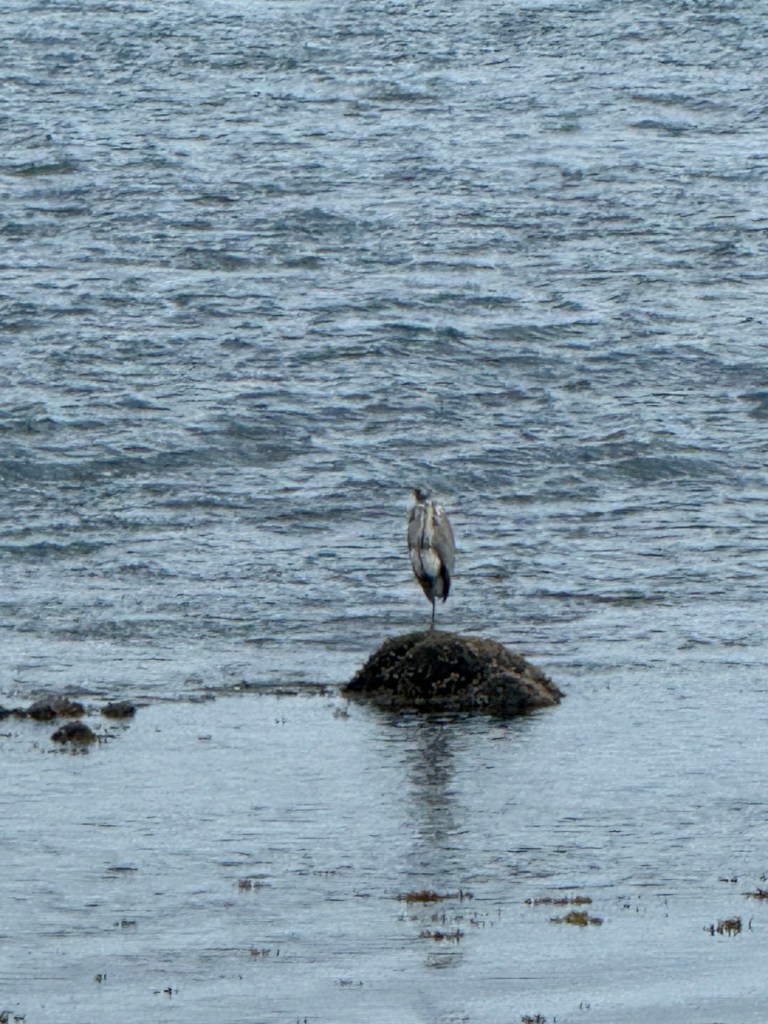
A quiet heron perched twenty feet from the shoreline
My day yesterday once again started with breakfast with a friend, followed by a slow, relaxing drive down the coastline to Dalhousie. It’s one of those things where you don’t appreciate what you have until it’s gone. After all, I spent almost thirty years in this area and drove that road more times than I could possibly count. But during in youth, I never appreciate the immense beauty of the open bay, rolling Appalachian Mountains or the wonderful views scattered all about the area. It isn’t until now, as an adult, that I’m able to look at all these sights and ask myself how/why I ever left this place. I was quickly reminded, mind you. But the thought was still there. You see, living in a bigger city has spoiled me, after all fashion. If it’s 10 o’clock at night and I decide I need a pizza, I have tons of options. If someone in our household is sick and needs something, i know of at least three 24-hour pharmacies in my city. There are no such availabilities in my home town where time has literally stood still, and the sidewalks almost literally roll up around dinner time.
The “Bon Ami” rocks
Once I reached Dalhousie, I got right down to business; visiting my folks. It’s been a difficult run this time around. My mother has become so tiny and diminutive, she’s almost the size of my 11-year son. She was semi-awake, but not responding to me in any meaningful way. She frowned and stared at me, almost as though she was wading through a very deep pool of memories, trying to determine who I was. Having learned my lesson on my last visit, I didn’t press her or try to explain that I was her son. I learned fairly quickly that it won’t help. I sat with her for a time, said my goodbyes and stepped out of her room. She didn’t even move enough to see me off or acknowledge my departure. I usually describe on these trips how strange it feels to come “home” with no home to come back to. After all, in the past, I would always go to my mother’s home. Always the steady rock of the family, she was always the one that arranged meals, gave me a place to sleep and took care of me when I visited. Now, I’m 100% a tourist in the very town I grew up in.
But this time, what I’ve realized that it’s far harder to recognize that the woman who was an absolute anvil, loud and full of life, who lifted me up and cradled me as a child, was now a tiny person the size of one of my own children and the person I knew is already forever gone. It’s a sobering thought that slaps one in the face with a dose of reality that life is short and fleeting. Things with my father weren’t much better. He’s now permanently on oxygen and doesn’t budge from his bed. He barely spoke to me, despite being awake. According to the staff, he’s also beginning to show signs of dementia, but I was able to converse a little with him. It felt like he was more focused on his television than on me. At one point, I even asked him if he wanted me to go so he could watch his show. All he did was grunt. I stepped out shortly after. The icing on the cake is the care home staff, who sit in their little alcove that covers all the entrances that one could use, who always seem to need to ask, “Leaving so soon?” Fuck off, dude. I don’t need your snide comments. Moving on.
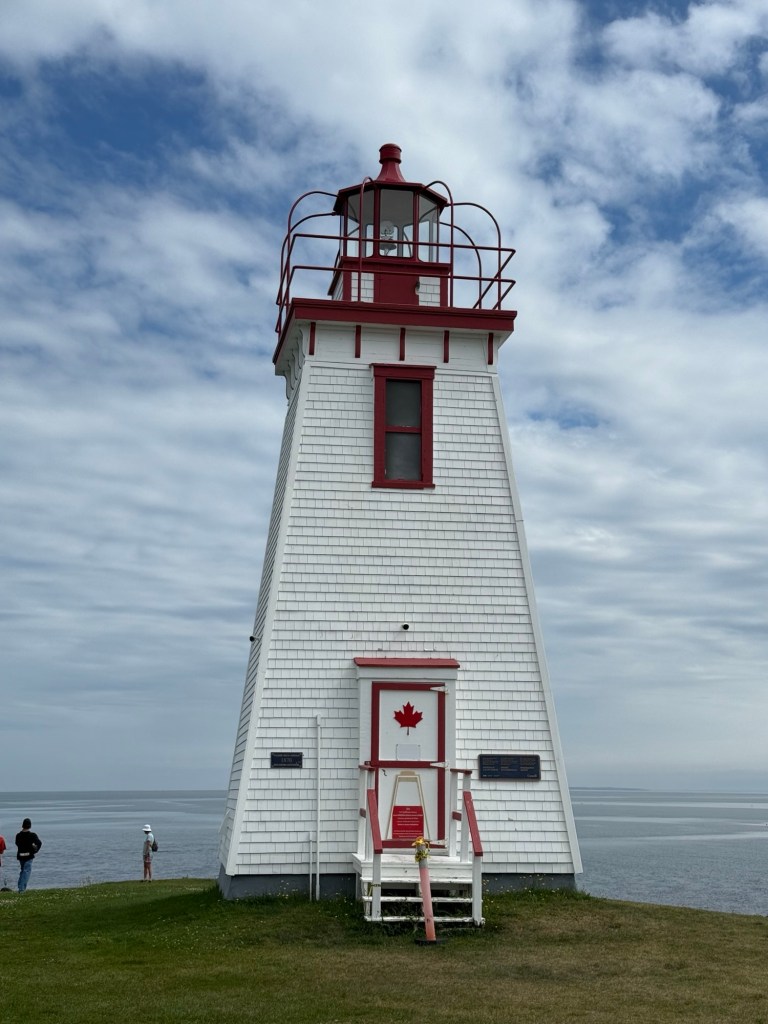
The famous Dalhousie light house. No longer functioning (and no longer needed)
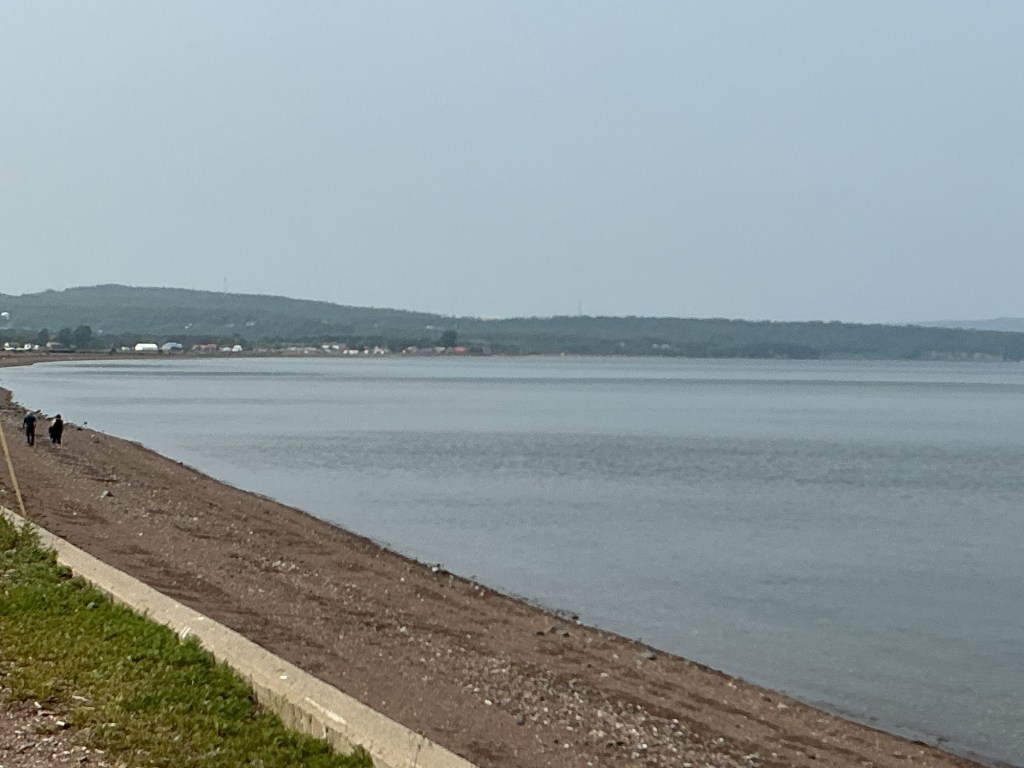
I moved through my afternoon by walking around the Inch Arran beach area, snapping the photos you’re seeing in this post and reminiscing about all the good times I’ve had when I lived here. The passage of time doesn’t change. The sea and the mountains don’t change. At least not on a scale that one perceives within their lifetime. But the one consistent change is the lack of familiar faces. No more locals that I knew or could connect with. I had the opportunity to visit with some dear friends but ironically, all of them except for my Sensei reside outside the immediate area. The biggest and headgear lesson of all is gaining the realization that despite I kept labeling this trip as “coming home,” this I any longer my home. And no longer a place that holds any purpose in coming back to. Obviously, my folks are still here and there will continue to be intermittent visits until they’ve passed on. But the charm and value of this place no longer exists for me. I miss my actual home. And my family. It will be good to get back.
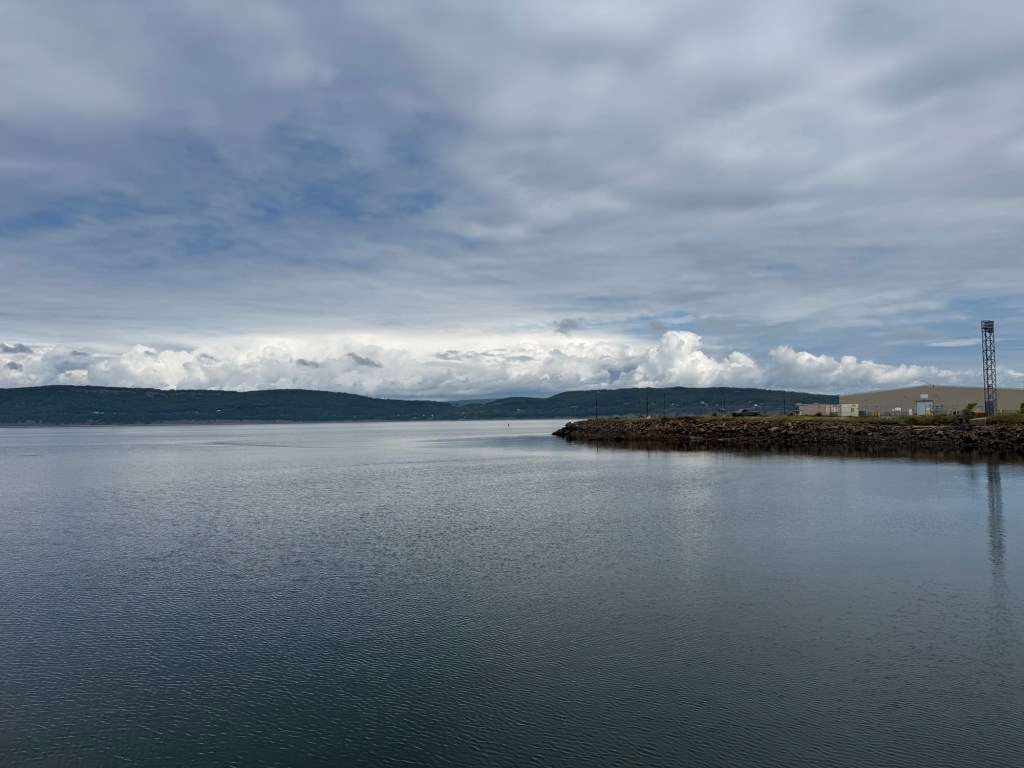
Baie Des Chaleurs (Chaleur Bay). The mountains you see is the Province of Quebec.
My evening concluded with a visit to my aunt and uncle, who made a wonderful spaghetti for supper. We shared great conversation and stories, my uncle showed me their new SUV and I even had the opportunity to go on a short drive on his side-by-side. I’ve never been on one before and it was quite fun. We wandered the woods, only for about fifteen minutes but he showed me all the functions of the machine and how fast it could go. I enjoyed it. Once the sun went down and it started getting dark, I respectfully bowed out and prepped to leave, especially since both of them were yawning intently and I knew they would both be up at dawn to go to work. Once back at my hotel room, I crashed unceremoniously and enjoyed the only day this week where I managed to sleep in past 7 am. Of course, I’ll have adjusted to this time zone just in time to fly back to Saskatchewan, which is 3 hours behind the time here. That should be entertaining.
I’ve often heard the expression “You can’t go home again.” I’ve never really understood that expression before because I’ve always believed that of course you can! It’s costly and takes time and effort, but one can totally go home. The real problem is that eventually, home isn’t home anymore. THAT’s the reality that people usually fail to understand. But I’ve learned that lesson this time around. When I leave New Brunswick tomorrow morning to head back to Saskatchewan, it will likely be for the last time except for coming back to bury my mother and father. A sad reality of life that can often be hard to swallow. But such is life. It will be good to be back with my family, and even go back to work. Hopefully, the place held up in my absence. I’m on my way now, stopping in to visit Sensei’s son and my “brother,” Guillaume, on the way. It will be good to see him. Tomorrow’s post will be the last Odyssey entry for this trip, but I’m sure I’ll have plenty to bitch about regarding the flights, travel in general and all the people I’ll have to deal with. Que sera… ☯️
Damn, it’s already here… My last day in the North Shore. I’ve would have thought the time would be long and I’d be bored to tears. But these past brought of days have actually flown by quickly. Yesterday was cold as hell, meaning I spent most of the day with the car heater running at every location I drove to. My best idea eggs grabbing a cheap hoodie at a local Walmart. Yesterday, much like the day before, flew by in a flurry of back and forth driving between Dalhousie and Campbellton. My morning started with a lovely americano at a little hole-in-the-wall coffee shop called The Early Bird Company. It was tiny and there was very limited seating, but we managed. I was sitting right next to the door and people kept coming in and out. The cold air was annoying as fuck, but it was counterbalanced by the lovely, rich flavor of my americano. This was a followed by an early lunch at the local McDonalds. The biggest surprise thus far was the fact that McD’s has started serving Red Bull. It seemed to be quite a matter to celebrate…
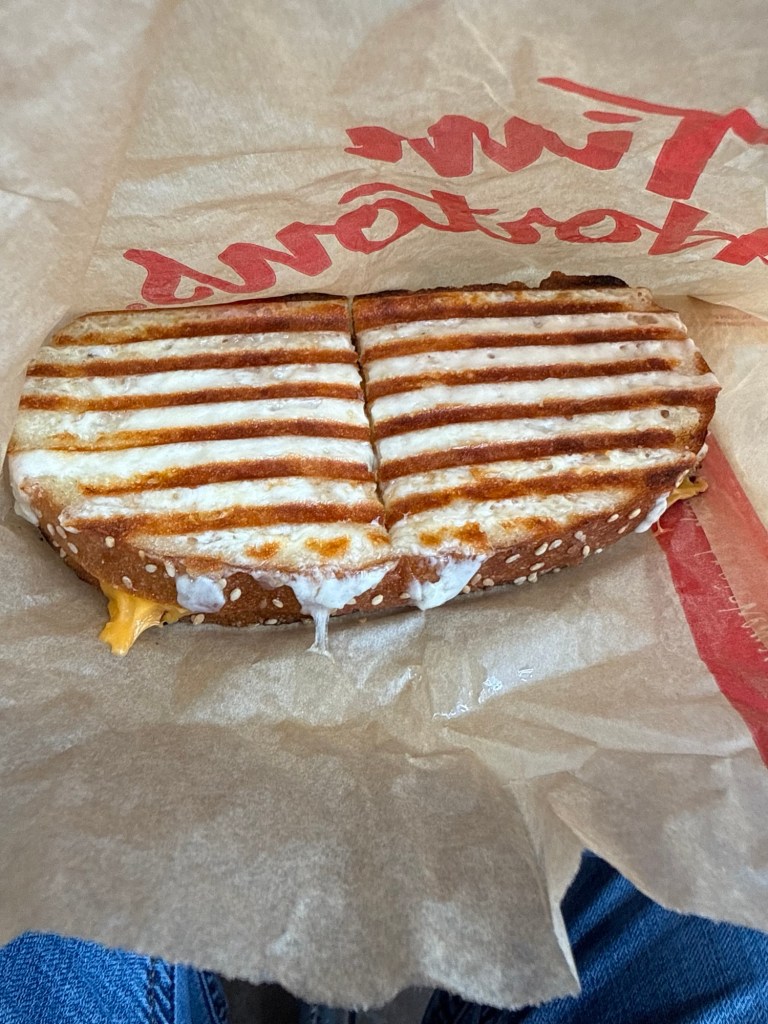
I mean, I didn’t HAVE any Red Bull, between the energy drink I woke up to and the americano. But it was definitely funny to see all the advertising in a place that’s intended to sell fast food. In recent years, I’ve come to figure that most well-known eateries have been trying to do too much. Seeing Tim Horton’s trying to sell pizzas was my breaking point but the good news is they’ve started carrying their grilled cheese sandwiches again. Let’s put a pin in that for a moment and get back to my day. Once we finished a lovely and inexpensive McChicken, I headed down to Dalhousie. It was strange to see my old work location (the McDonald’s) as quiet as it was over the lunch hour. When I worked there, the noon hour was akin to going into battle. The flood of people that would cycle through that place was nuts. But there was barely a trickle of less than a dozen folks.
After heading down to the Dalhousie area, I tried for the second time to stop in at a little bakery called Le Moulin a Cafe, or Coffee Mill, in English. One of the key things I try to get done on any visit to my parents, is to enjoy a slice of sugar pie. For some reason, no one outside of New Brunswick seemed to know what the hell a sugar pie IS. Essentially, and depending on the recipe one uses, it’s basically brown sugar, condensed milk and melted butter combined into a pie crust. It’s rich, decadent and delicious. I’ve been told there are similarities with butter tarts, but the size of a pie instead of tiny bullshit. And there are no raisins or pecans in it like a butter tart. But I digress… It’s without a doubt the worst thing that a Type-1 Diabetic can eat, given how fattening and sugary it is, but it’s a once every couple of years’ sort of indulgence. So, I make my peace with enjoying a slice when I’m in Northern New Brunswick.
The lovely, melty cheese miracle that is Tim Horton’s Grilled Cheese
Anyway, I rolled up on the coffee shop for the second day in a row and for the second day in a row, the damn place was closed. ON A MONDAY? During the summer? With all the campers and tourists floating around? That’s a fair amount of lost income for that business. And people wonder why nothing that opens is ever successful in this area. Bloody hell. I was meeting an old friend of mine, who ironically is named the same thing as my uncle. But this particular individual not only graduated high school with me but also did karate with me for several years and came to Japan with Sensei and I. I’ve known him for decades and he still lives in the area. For some reason, I don’t always remember to drop him a line when I’m down here, which is an oversight I need to correct. But we met at Tim Horton’s and enjoyed coffee and good conversation. We caught up on things nicely. It was good to see him.
This was followed by an extremely short visit to see my father, who was sleeping heavily. The staff at the nursing home kept offering to wake him, but given the pain he’s in, if he’s actually getting some sleep, I’m inclined to let him do so. Since there was no conversation to be had and I’m never one to just sit there and watch my father sleep, that’s where I ventured out and tried to get some sugar pie. But I substituted with a stop at a drive-in food canteen that I actually worked at when I was a teenager. I was jonesing for a cheeseburger. The burgers there are butter-seared on a flat range and served on a toasted burger buns that was toasted by laying in on the range with butter, as well. It’s a fatty, decadent burger that tastes like childhood. I’m starting to notice that the items I tend to have when I come back home are all ridiculously bad for me. But que sera…
My day wrapped up with a coffee meeting with an old karate friend. Once again at Tim Horton’s. Yet another person I’ve known for Swansea and that I try to connect with on every trip. Once I was done with Dalhousie, I came back to the hotel and crashed unceremoniously. And now, the last day on the North Shore can begin. Tomorrow will see me check out of the hotel, load up the car and reached south to Moncton. I’m the way, I should be stopping in to modify Sensei’s son to catch up with him. Then, a short night’s sleep at a hotel next to the airport before I board a terribly early flight back to the Prairies. It will be good to go home. As predicated during my Day 1 post, being here has elicited too many emotions for my cast iron personality to handle. ☯️
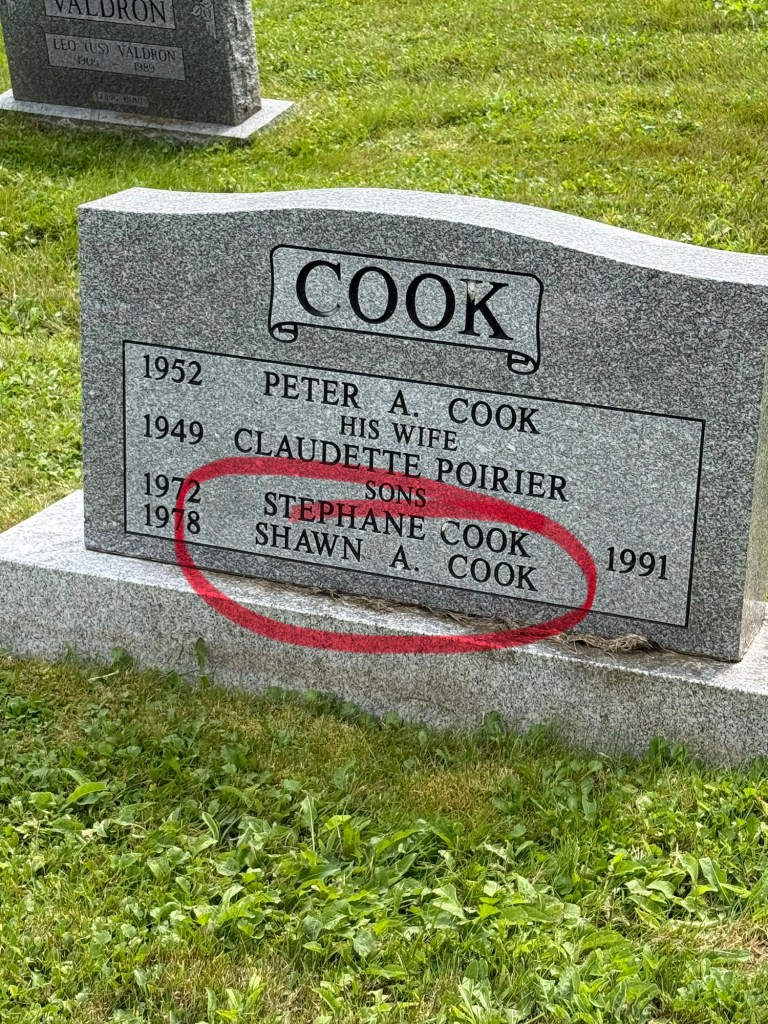
So, yesterday was pretty decent. After a night’s sleep, I had some breakfast would. Dear friend, which filled me enough until supper time. Good ol’ Ozempic; that shit’ll kill your appetite. But I had a classic omelette with bacon and toast. Quite delicious. This was followed with a drive around Campbellton to see what;s changed, which turned out to be quite a bit. Once I dropped my friend off, I made my way down to Dalhousie. As is usually my habit, I stopped in to see my brother first. Buried in 1991, I always make a point of stopping there first since, despite the fact I lost my only brother when he died, there’s no planning involved, no scheduled visits; it’s come whenever you can and go when you’re ready. I don’t think I’ll ever get used to seeing my own name on a headstone, though. To explain a bit, my mother had the foresight a few years ago to have the ENTIRE family engraved onto her and my father’s headstone. So despite my brother being buried in the plot right next to where my mother and father will lie, she had his name and mine added onto their stone. No idea why. And she came down with dementia before I could ever get an answer out of her.
Messed up, right?
Despite the morbid nature of that initial stop, followed by some random elderly lady asking me if I was “there for the burial,” (I didn’t stick around long enough to figure out what she was talking about) the weather was beautiful, the views were amazing and I enjoyed a nice, quiet, nostalgic drive through the area. One of the beauty parts is that I have reached a point in my life where I can make my way through the area I grew up in without encountering anyone from my past. This makes for a much quieter tour. The memories were great and I managed to grab a couple of items that I didn’t find on my way up upon my arrival. It amazes me how dollar stores and pharmacies in a city of 18,000 people seemed to have less items available than a small town of approximately 3,000 people. That’s right; Dalhousie only has about 3,000 people, none of which seemed to know who I am. I stopped in at a little coffee shop in Charlo called The Coffee Mill, which serves the absolute best sugar pie I’ve ever had in my fuckin’ life. Unfortunately, since it was Sunday they were closed.
I followed up by buying a few packages of tortillon cheese, which is a firm, overpriced cheddar that I can only find in New Brunswick or Quebec. I snacked on some last night crusty I crashed. I stopped in on my folks. My mother was out like a light and my dad was rather out of it, but I got to see them. I got to chat with the care home staff about my father, who is slowly joining my mother in secrets. Great! And he’s now on oxygen permanently, which is helping prevent further unnecessary hospital trips. The only uncle I have left in the area invited me to dinner but I already had plans to visit Sensei at 5 o’clock when I was done with my parents, so we rescheduled for Tuesday. Hard to believe how someone with no one to see and nothing to do in the middle of small-town-in-the-middle-of-nowhere New Brunswick has so many plans. So figure.
The view of Dalhousie from Charlo Beach
I stopped in at Sensei’s house at 5 o’clock sharp. I had emailed him prior to flying out and asked when a convenient time would be. He mentioned eager evening, so I asked if 5 or 6 would be best. He never got back to me and in keeping with my obsessive gambit of always being early or else I’m late, I showed up at 5. His wife was unfortunately in the middle of prepping supper for them, which made me feel bad, so I offered to come back in an hour. But they insisted I join them for supper and she was making a seafood spaghetti, so I couldn’t refuse. I mean, getting actual fresh seafood of any kind in Saskatchewan is impossible, so I had to indulge. Supper was amazing and the conversation was good. We shared stories of the past and Sensei even discussed some of his time during his policing years, which he’s never done before. It was fun, nostalgic and touching, with a mild, minty hint of plenty of work to do as far as my karate training goes. He even offered to correct one of the katas I had been having an issue doing properly. We chatted well into the sun going down and I left his home much later than I had planned.
I had initially intended to have a late dinner with another local friend after I was done at Sensei’s, but I left late enough that I just came back to the room and called it a night. I should have known better than to make plans on the same evening as meeting with Sensei. Time melts away when we talk, and trying to make scheduled plans never work out. In fact, he seems to be the only individual with whom I will completely ignore the outside world and even neglect looking and/or answering my phone. It was a good time but I will admit that the time difference between here and Saskatchewan was impulse to tire me out so I passed out like a toddler once I got to the hotel room. One bonus during my liturgy drive around, is seeing the childhood home that I was born in…
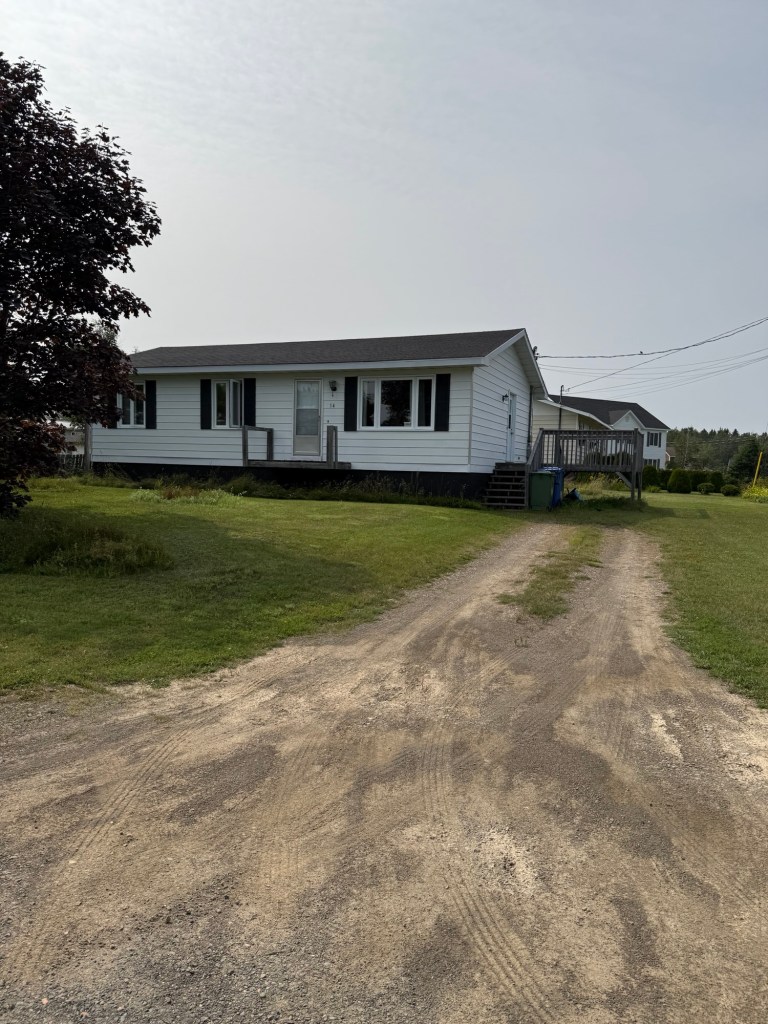
It was a little disheartening seeing the state of the place, bearing in mind it was only bout in the early 1970’s. But having lived there until I was about four, vividly memories came back of playing on the deck and some of the shenanigans I got into in the back yard. Unlike most people and for some reason, I have memories as far back as when I was about two years old. Although most “experts” claim that should be possible, but they’re there nonetheless and I had those memories confirmed many years ago. So, those experts can go fuck themselves. I know what I know. Anyhoo, as I’ve wrapped up my first full day in my home town area, I need to prep for another visit to my parents and coffee later tonight with my good fried Ricky. It’s pouring rain here today, which will make it colder than it was yesterday. I had the foresight to purchase a zip up hoodie for $10 at a local Walmart. But I don’t have a fucking rain jacket, so my Lululemon windbreaker will have to do. Yes, I wear Lululemon gear! They have guy stuff, so don’t freakin’ judge! But if you’ll excuse me, time for a nice, hot shower before venturing out into the rain. Let’s get the second day of the shit-show started… ☯️
Alright, I finally made it to the North Shore of New Brunswick. It was a hell of a day, and I’m going to start by telling you all about it. First and foremost, my departure flight from Regina was delayed. Go figure. The flight was reasonable. I watched a movie on my iPad and the folks sitting next me to slept the whole way through. Perfect. Once I landed in Toronto, and reactivated my phone, I got hit with a plethora of texts and emails from Air Canada. “Your flight has being delayed to 14:20.” Then, “You’re flight has been delayed to 14:50.” FML. Every little bate later I am on the tail end of the trip delays my ability to drive the three and a half hour drive from Moncton to Campbellton where I would staying during my stay. It was almost 4 o’clock by the time I finally boarded the last flight of the trip, uncertain if my car rental would still be waiting for me when I arrived in New Brunswick and contemplating my alternatives while I flew.
When I finally arrived in Moncton, I was like most of the people who walked off the plane; I was tired, exhausted, and not quite sweaty but yet, somehow still sweaty. The kind of condition that only comes from being someone with PTSD cramped in a confined space while surrounded by hundreds of people. All I wanted to do was get my rental vehicle and get the last leg of the trip out of the way. No such luck. My vehicle was delayed. First, it was only supposed to be “10 to 15 minutes.” Says them. I used the washroom. I took a walk. I spoke to some of the locals. Can’t back to the counter and was told, “We’re still waiting on some of the vehicles to be ‘brought up.’” Oooookay… I wasn’t certain what the fuck that means, but I’m not a big fan of waiting, especially after Enoch on the go since 3 am and it was already after 7 pm, meaning I wouldn’t reach my hotel room until after 11 pm. An old man like me usually tries to hit the sack by no later than 9 pm. Not tonight, dear reader. Not tonight.
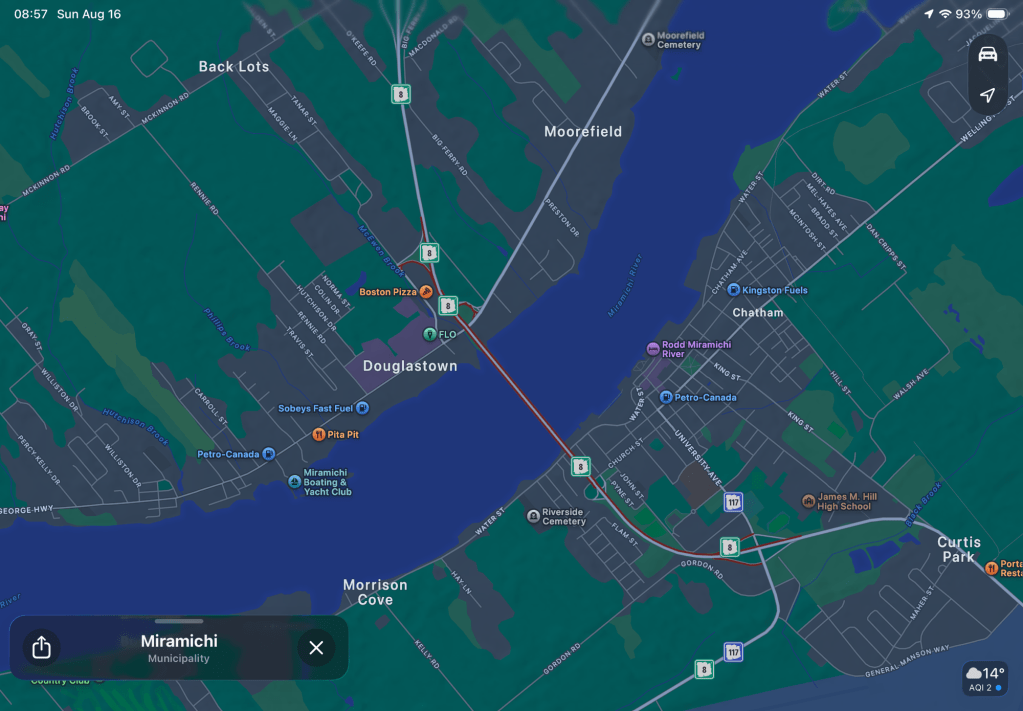
Mao of the bridge through the Miramichi River
I thought that once I had my rental vehicle, I could put all the delays behind me and just get to Campbellton. No such fuckin’ luck. I had planned on stopping in Miramichi for dollar store supplies and snacks for the hotel room. Turns out, the Centennial Bridge that crosses the Miramichi River was closed for construction. Maybe it was the delirium setting in from traveling all day, but I started to feel as though fate was conspiring against me to prevent me from reaching my destination. To add insult to injury, the detour required an additional 40 minutes of driving to get around to the next bridge. Traffic didn’t help. I shouldn’t need to tell any of you how messed up it can be, when you redirect hundreds of cars to a singular detour point. And we all know just how much I love waiting on others. Once I crossed the detour bridge and made my way back into town (or I guess they call it a “city,” now that they’ve amalgamated), I stopped at a local pharmacy chain for some travel supplies. I don’t like being civilly liable, so I won’t say which chain it was. But y’all are smart enough to figure it out.
I grabbed the basics. Soap, shampoo, antiperspirant, toothbrush and toothpaste. I grabbed some Skittles in case my blood sugars dropped and a large bag of Ruffles chips to chew me through any snacking cravings I get during in stay. What would have normally cost me about twenty dollars getting all of this stuff at a dollar store or Walmart, it cost me almost sixty dollars at this pahrmacy. Despite it being the same stuff, same size, just a different location. Great. Next, I needed food. The last I had eaten was a small tray of sushi rolls almost nine hours previous. I tried stopping at a Tim Hortons for a grilled cheese melt. I’ve been dying for one of those since they came back on the menu. But such chance. Doors were locked. I encountered the same issue with Burger King. What. In. The. Actual. Such. It’s Saturday night, folks! And two major fast food chains are closed and locked before 9 pm. I finally found success with a local McDonald’s and grabbed a coupe of sausage McMuffins.
The messed up detour in Miramichi
I finally got on the road and reached the doors of my hotel around 11:30 pm. I was checked in by a very nice young man that I was pretty convinced was outside smoking up when I arrived. While it’s no longer illegal in Canada and I have no issues with someone doing it, doing it while on the job and making me wait at the very tail end of my journey when a bed is literally feet away and waiting for me was more than my recently-found calm could manage. My veneer cracked. Luckily, I made my way into my room and unceremoniously crashed after quickly downing my evening meds. The big thing being today’s post is that travel, even domestic travel, is no longer a guaranteed and safe means of making any destination in a planned manner. It didn’t matter that I had car and hotel reservations waiting; my flights were ridiculously delayed. Didn’t matter that I was tired and still had over three hours of driving to do, roads had me detoured. None of that really mattered to any extent. I surprised myself by maintaining my calm, not yelling at anyone and not losing my cool.
This morning, I still woke up around 7 am, which is fucked up considering that’s only 4 am back in Saskatchewan. You’d think that the time difference would have seen me sleeping in at least a little bit. I tried a different hotel than my previous stays because I wanted to change things up and it was a touch cheaper. Now, I know why. After grabbing a hot shower and getting my clothes unpacked of ride next few days, I discovered that the walls are quite thin. At least everyone was quiet during the overnight hours. Now, I’m off to see what delicious, gourmet breakfast I can find in my previous home environment. Then, I hope to kick things off by visiting my folks and possibly seeing Sensei this evening. The first day on the North Shore is already planned and mapped. We’ll see if at least one thing can go according to plan.
The view of Sugarloaf Mountain through my dirty hotel window
As I wrote in yesterday’s post, a lot of mixed feelings about being here. Memories and old landmarks are pulling me back to a couple of decades ago. Many things have changed, including a number of towns and villages along the main highway that weren’t there before, even a year ago when I was here last. Old businesses have made way to new ones, some buildings that have been there my entire life have been demolished or rebuilt. I’ve often heard that you can never go home again. Well, that’s only partially correct. You can go home; it just may not be the home you remember. I’m looking forward to seeing my parents. We’ll see how well THAT visit goes. But that’ll be an update for tomorrow’s post. ☯️